Efforts Towards Energy Efficiency: SmartThings Energy & Home Appliances
SmartThings Energy: Optimizing Energy Efficiency in Home Appliances
Home appliance energy monitoring
Users of our home appliances can monitor their energy consumption using SmartThings Energy*. Energy usage is tracked based on carbon emissions, allowing users to view the energy saved through AI Energy Mode and solar power use. Through this service, users can prevent excessive electricity bills and estimate their end-of-month electricity costs by setting target consumption levels.
- To use SmartThings, download the app from the Galaxy Store, Google Play Store, or Apple App Store. The supported OS specification, required storage space, and other usage environment for the SmartThings app can be found on the app download page in each app store. SmartThings has compatibility constraints, and the compatible environment may be updated periodically. Supported OS specifications and app screen configuration may change with app updates. The availability of technology, functions, features, and services may vary by country, service provider, network environment, or product, and may change without notice. All devices must be connected to Wi-Fi or other wireless network, and registered with a single Samsung Account. SmartThings features and specifications may vary depending on the product and region/country.
AI Energy Mode
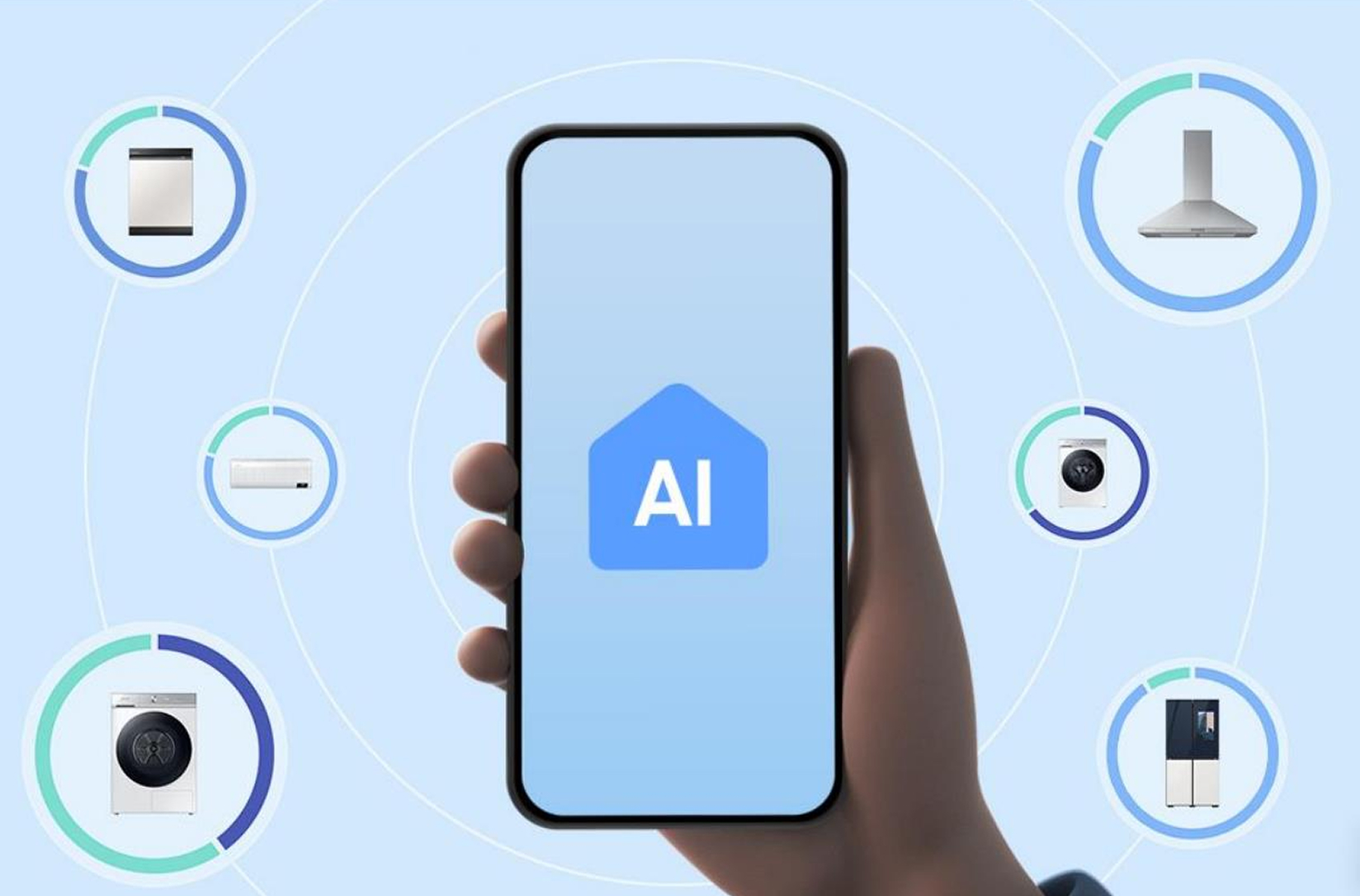
Users of our home appliances can reduce their power consumption with AI Energy Mode*. They can actively reduce their carbon footprint by configuring their appliances to operate in AI Energy Mode during periods of high grid carbon intensity. This mode is available across a wide range of appliances, including refrigerators, dryers, air purifiers, and range hoods. Further information can be found in the product specifications on Samsung.com.
- The "Carbon intensity" option becomes available when AI Energy Mode is activated.
| Refrigerators1) | Dryers2) | Air conditioners3) | Dishwashers4) |
|---|---|---|---|
| Level 1: Approx. 15% Level 2: Approx. 25% |
Approx. 35% | Approx. 30% | Approx. 20% |
- Refrigerator
- AI Energy Mode activates immediately when you select "Maximum saving" in the "Set monthly target" tab. If set to "Tiered billing" or "Custom," the operating time and energy-saving levels of AI Energy Mode may vary depending on the conditions set by the user in each mode.
- Test conditions: Freezer at -19℃, Fridge at 2℃, FlexZone set to Freeze
- Test mode: AI Energy Mode
- Test methods: 16 hours with door openings / 8 hours without door openings (including 4 hours of ice making), comparing daily (24-hour) power consumption with AI Energy Mode on and off (Door openings: Fridge 28 times, Freezer 5 times, FlexZone 5 times)
- Test environment: Ambient temperature 25℃, humidity 50%
- Test model: RF85B97A1*
- Results are based on our internal testing and may vary depending on the actual usage environment.
- Using AI Energy Mode Stage 2 may reduce the shelf life of stored food.
- The actual energy saving rate from AI Energy Mode may vary depending on the model and actual usage.
- Dryer
- AI Energy Mode activates immediately when you select "Maximum saving" in the "Set monthly target" tab. If set to "Tiered billing" or "Custom," the operating time and energy-saving levels of AI Energy Mode may vary depending on the conditions set by the user in each mode.
- Test conditions: 3 kg of IEC test load
- Test cycle: AI OptiDry (with fabric type detected as Standard)
- Test methods: Comparing power consumption with AI Energy Mode on and off
- Test environment: Ambient temperature 23℃, water temperature 20℃
- Test model: DV20B9760ME
- Results are based on our internal testing and may vary depending on the actual usage environment.
- Drying time may increase when using AI Energy Mode.
- The actual energy saving rate from AI Energy Mode may vary depending on the model and actual usage.
- Air conditioner
- AI Energy Mode activates immediately when you select "Maximum saving" in the "Set monthly target" tab. If set to "Tiered billing" or "Custom," the operating time and energy-saving levels of AI Energy Mode may vary depending on the conditions set by the user in each mode.
- Test conditions: 35℃ / 24℃ (standard cooling conditions)
- Test mode: AI Comfort
- Test methods: Comparing power consumption with AI Energy Mode on and off while operating in AI Comfort mode
- Test model: AF25BX934WAR
- Results are based on our internal testing and may vary depending on the actual usage environment.
- AI Energy Mode can be set in steps, with maximum savings of 10% in Stage 1 and up to 30% in Stage 2.
- When using AI Energy Mode, the compressor's operating speed and target temperature are adjusted, and the target temperature may increase by up to 2°C.
- Dishwasher
- AI Energy Mode is activated immediately when set to "On" in the SmartThings Energy service, and the operating time and level of energy savings may vary depending on the environment and usage conditions.
- Test conditions: IEC 60436
- Test cycle: Pots and Pans
- Test methods: Comparing power consumption with AI Energy Mode ("Maximum saving" selected) on and off
- Test environment: Ambient temperature (23±2)℃, relative humidity (55±5)%
- Test models: DW60CG880B00, DW60DG770B00
- Results are based on our internal testing and may vary depending on the actual usage environment.
- Operating time may increase when using AI Energy Mode.
- The actual energy saving rate from AI Energy Mode may vary depending on the model and actual usage.
Verifying Carbon Reduction Effects Achieved by Our Washer's AI Energy Mode
At DX Division, we optimize the energy consumption of connected appliances based on consumer usage patterns via AI Energy Mode. To more accurately measure and verify the reduction effects, we are actively engaging in the establishment of international standards. Since 2023, we have participated in the Decarbonizing the Use-Phase of Connected Devices (DUCD) initiative led by the Carbon Trust, a global carbon verification institution. Collaborating with global IT companies, we jointly developed measurement standards and reduction methodologies based on real-world usage data. In 2024, this collaboration culminated in the publication of standardized guidelines capable of consistently calculating the energy consumption and savings effects of connected devices.
In 2025, as an industry first, we substantiated the energy savings of high-efficiency washers equipped with AI Energy Mode through a third-party verification process based on these DUCD standards. An analysis was conducted on approximately 187,000 high-efficiency washers actively used across 126 countries over a one-year period, from July 2024 to June 2025. The results revealed that utilizing AI Energy Mode saved 5.02 GWh of energy, which accounts for approximately 30% of the appliances' total energy consumption. This resulted in a greenhouse gas reduction of approximately 2,084 tCO₂e. This verification marks the first instance of quantitatively substantiating the carbon reduction effects of connected devices in real-world usage environments in accordance with international standards. Its significance lies in the fact that it serves as the foundation for practically managing and expanding emission reductions during the product use phase. Building on this momentum, DX Division plans to further expand energy savings and carbon emission reductions during the consumer's product use phase through the SmartThings platform and AI-based energy management features.