Air and water pollution management activities
Air and Water Pollutants
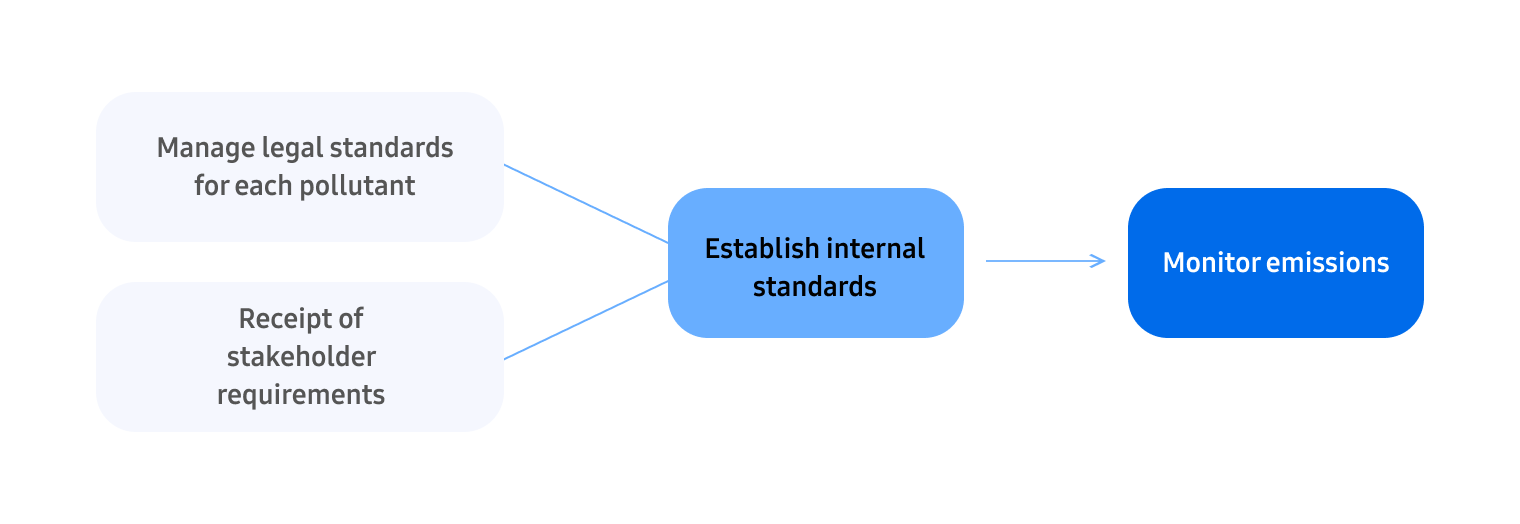
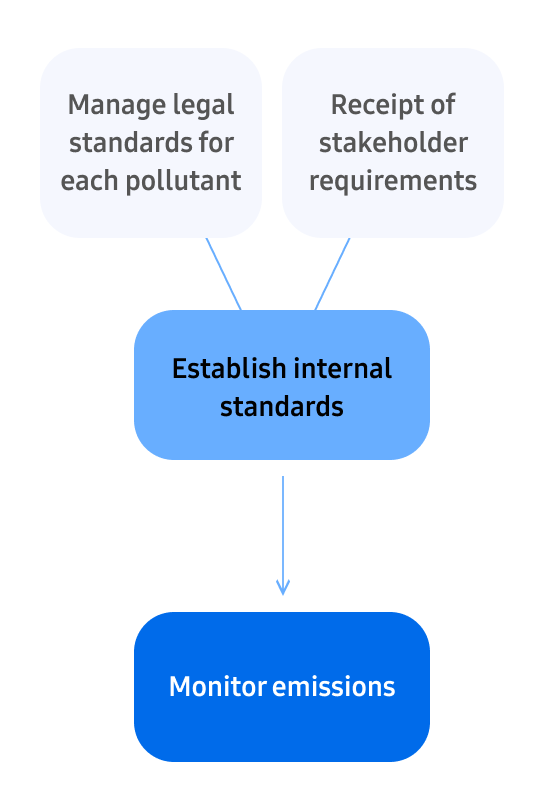
We manage air and water pollutants to ensure compliance with legal emission standards and have established internal emission standards to meet the requirements of stakeholders and minimize environmental impact.
Pollutant management process
Minimizing water pollutant discharge
DX Division applies legal requirements* and thorough internal standards to minimize the discharge of water pollutants and consistently monitors compliance with its own standards by increasing the frequency of wastewater discharge analysis beyond legal requirements. Additionally, the division ensures that the water pollutant prevention facilities maintain at least 10% spare capacity at all times to prepare for unexpected increases in pollutant influx, thus securing the seamless operation of the facilities.
DS Division applies legal standards* and thorough internal standards to comply with legal regulations on water pollutant discharge. To meet these standards, the division employs optimal prevention technologies, manages the wastewater treatment process in four stages, and purifies the water through advanced treatment facilities before discharging it into local rivers. Furthermore, the division monitors the entire wastewater treatment process from the Central Control Room to maintain strict control over the concentration of pollutants in discharged water. Except for emergency actions like on-site valve control, all treatment steps have been automated.
DS Division is also developing pollutant discharge minimization technologies, aiming to process pollutants to 'natural state' levels in the long term. To reduce chemical usage, the division modifies process recipes, reuses chemicals used in production processes at other facilities, and researches and develops filtration technologies that can selectively separate and remove specific substances. It also continuously works to enhance treatment efficiency by optimizing processes with best available prevention technologies in its wastewater treatment operations. In addition, the division is exploring substitutes for hazardous substances.
- * Act on the Integrated Control of Pollutant-Discharging Facilities
-
-
Minimizing water pollutant
discharge -
- Reducing chemical usage
- Developing filters to remove chemical substances
- Developing substitutes for hazardous substances
- Improving the efficiency of wastewater treatment process
-
Establishing a multi-layer defense system for water pollution
DX Division has installed redundant key components in its pollution prevention facilities to ensure uninterrupted operation in the event of a malfunction or other incident. At final rainwater discharge points, the division has deployed containment systems such as automatic gates and valves, as well as monitoring equipment like sensors and CCTVs, enabling the immediate shutdown of pollutant discharge in emergency situations.
DS Division is prepared for possible environmental accidents at wastewater treatment plants. We have installed triple interception facilities across the inlet stage, process stage, and discharge stage of the wastewater treatment plant. Each interlock is activated in real time to initiate an emergency recovery of wastewater when the pollutant concentration is assessed to exceed our standards. This prevents untreated wastewater from being discharged into the river. At the Austin site in the United States, a retention pond, equipped with a real-time pollutant monitoring system, is located upstream of the outlet into the discharge stream. If any untreated pollutants are detected, the discharge outlet is automatically shut off.
- Inlet stage
- Process stage
- Discharge stage

Minimizing Air Pollutant Discharge
We manage air pollutant emissions in strict compliance with legal requirements*, guided by rigorous internal standards. We apply best available technologies and have established a multi-stage treatment system (Stages 1 to 3) according to the characteristics of each pollutant. To prevent unexpected environmental accidents involving air pollutants, backup treatment facilities have been installed across all lines, and a real-time monitoring system has been implemented to proactively address potential issues.
To ensure that air pollutants generated during production are emitted at levels that do not impact the surrounding environment, we are continuously developing and applying pollutant treatment technologies. To reduce nitrogen oxides, we have installed additional wet treatment facilities that combine ozone oxidation and absorption, alongside ultra-low NOx burners and Selective Catalytic Reduction (SCR) systems. We have also replaced existing boilers with low-energy steam supply systems. In addition, we are developing membrane-based adsorption technologies, advanced treatment technologies that utilize ambient and high-temperature plasma and catalyst systems, and integrated treatment technologies designed to enhance treatment efficiency.
- * Act on the Integrated Control of Pollutant-Discharging Facilities
Seasonal PM* Management
- * Particulate matter
Samsung Electronics participated in the Korean Ministry of Environment's voluntary seasonal particulate matter management (for 2 years between February 2023 to March 2025) to strengthen the target concentration of nitrogen oxide by 10% compared to the legal standard during the control system season (December-March) and agreed to operate prevention facilities in optimal conditions.
Learn moreVoluntary Agreement to Reduce Air Pollutants
The Gwangju site participated in the Voluntary Agreement to Reduce Air Pollutants, hosted by the Yeongsan River Basin Environment Office in 2023. Under the terms of this agreement, we fulfilled our commitment to reduce annual emissions of three air pollutants, including nitrogen oxides, sulfur oxides, and dust, to below 95% of the total allowable amount. We are currently preparing for a new agreement to take effect in 2025, following the expiration of the existing agreement in 2024.
We understand our responsibility towards the local community and will continue our efforts to reduce air pollutant emissions, contributing to a healthier local environment and improved quality of life for residents.