Human Rights Due Diligence
Samsung Electronics strives to identify, prevent, mitigate, and address actual and potential impacts on human rights throughout our global operations, supply chains, and business relationships in accordance with international standards. We integrate findings and insights learned from the due diligence into our process to ensure that appropriate policies and management systems are in place.
In addition, we consider increasing the frequency and scope of due diligence in response to specific circumstances, such as entering new regional markets, initiating partnerships with new suppliers, or addressing emerging human rights issues in the global landscape.
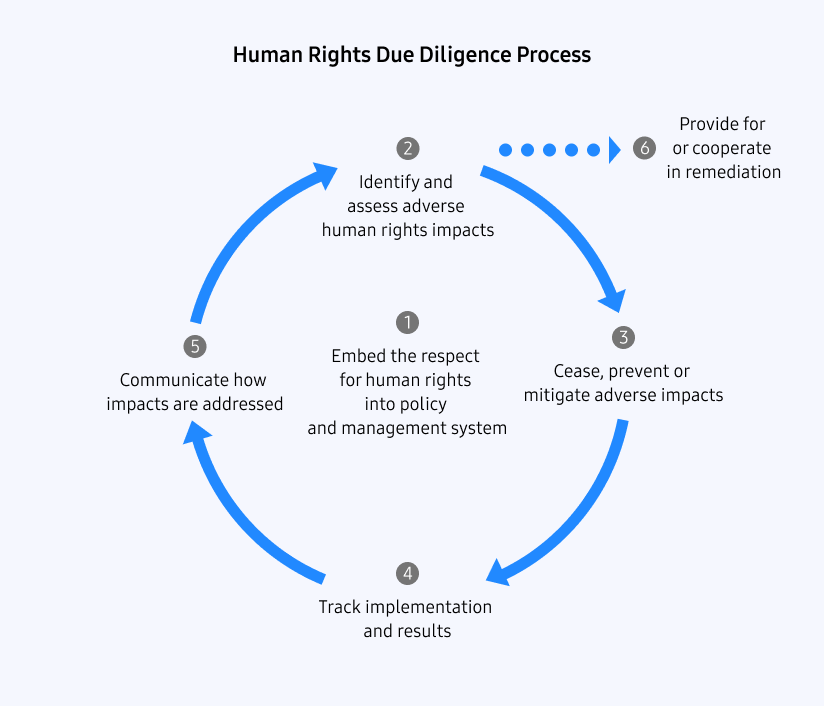
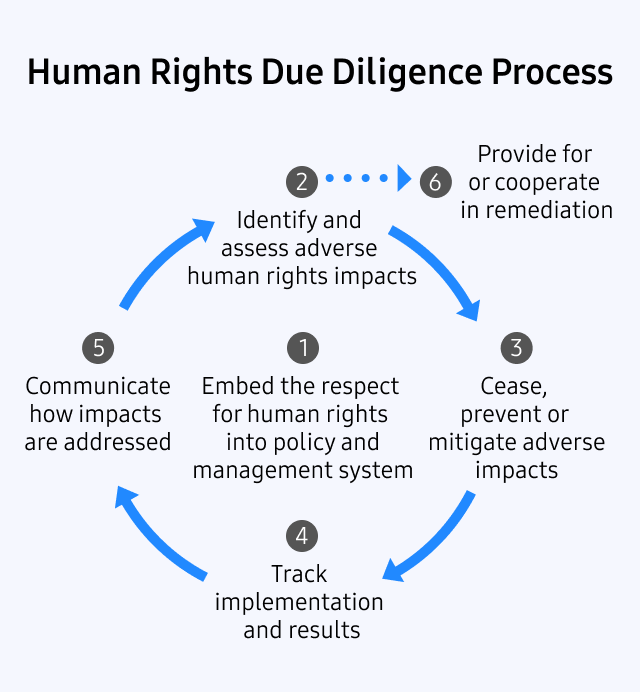
Human Rights Risk Management Process
In 2023, we hosted our first human rights stakeholder workshop, bringing together representatives from the International Labour Organization (ILO), the UN, global NGOs, and labor unions. During this event, we discussed our approach to human rights due diligence and integrated the resulting feedback into our human rights risk management processes. In 2024, to ensure full compliance with emerging human rights due diligence legislation worldwide, we initiated a comprehensive review and enhancement of our overarching human rights risk management framework. Building on this, in 2025, we evaluated the execution status of our regional human rights risk management plans. We also developed a standardized checklist, enabling our sales subsidiaries and research centers to conduct self-assessments as part of their own due diligence systems.
-
 Identification of key risks
 -
 Assessment of management priorities for key risks
 -
 Development of solutions and mitigation plans for negative impacts
 -
 Implementation of plans and effectiveness tracking
 -
 Grievance resolution and provision of effective remedies
Identification of Key Risks
We define our salient human rights risks as the human rights areas that could be most severely affected by our business operations.
Our risk identification begins with a comprehensive analysis of various sources, including human rights due diligence results, NGO reports, media articles, stakeholder dialogues, organizational culture assessments, and employee grievances. Salient human rights issues are selected taking into account their impacts not only on our business but also on internal and external stakeholders and rights-holders. We place a special focus on vulnerable groups within the electronics industry, such as women, migrant workers, and young workers.
Through this process, we identified 11 salient human rights risks, which were disclosed in the Samsung Electronics Human Rights Principles in February 2023.
Assessment of Management Priorities for Salient Human Rights Risks
As a global company operating in more than 70 countries, Samsung Electronics recognizes that the order of priority among human rights risks may vary depending on the economic, political, and cultural characteristics of each region. Accordingly, we have conducted Human Rights Risk Assessments (HRRA) by region, including Europe, the Middle East, North America, Latin America, and Asia.
HRRA was conducted for each region in the following steps:
- Assessing salient human rights risks for each subsidiary within each region, evaluating risk severity and likelihood.
- Creating regional heat maps based on the assessment results, categorizing each risk into three levels: high, medium, and low.
- Convening regional workshops where subsidiaries discussed the validity of the heat maps and subsequent risk management plans
- Engaging with external stakeholders to gather feedback on the heat maps and management plans prior to finalizing the assessments.
-
- Assessing key human rights risks by region
-
Each subsidiary within the region evaluates risk severity and likelihood.
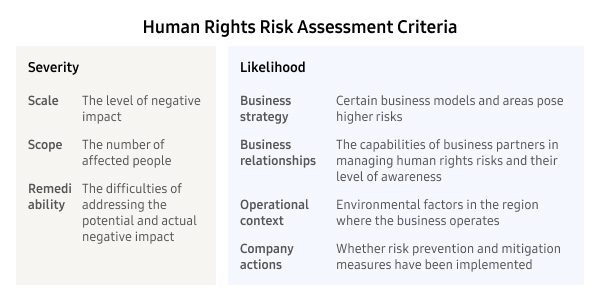
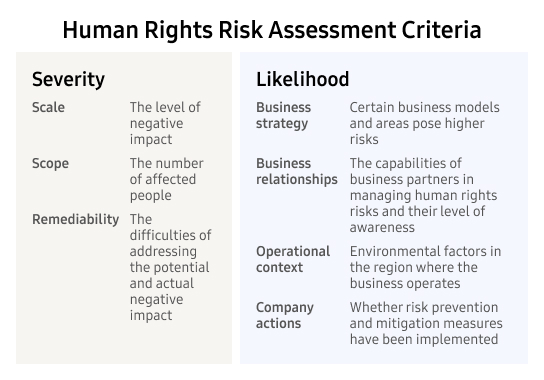 Severity: Scale (the level of negative impact), Scope (the number of affected people), Remediability (the difficulties of addressing the potential and actual negative impact)
Likelihood: Business strategy (certain business models and areas pose higher risks), Business relationships (the capabilities of business partners in managing human rights risks and their level of awareness), Operational context (environmental factors in the region where the business operates), Company actions (whether risk prevention and mitigation measures have been implemented)
-
- Creating regional heat maps
-
Based on the assessment results, each risk is categorized into three levels:
high, medium, and low.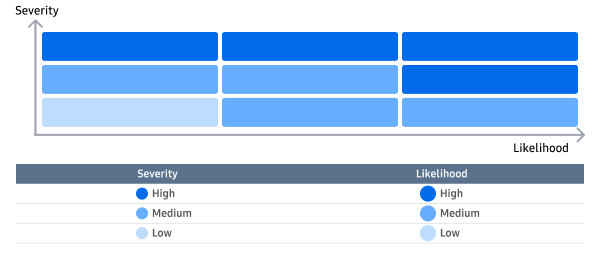
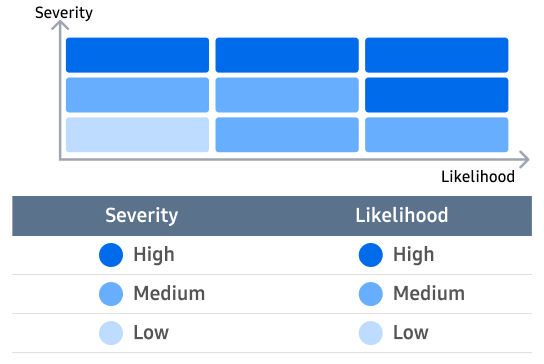 A 3×3 grid with Likelihood (Low, Medium, High) on the X-axis and Severity (Low, Medium, High) on the Y-axis. Cells become darker blue as both severity and likelihood increase. Legend: Severity — High (dark blue), Medium (medium blue), Low (light blue) / Likelihood — High (dark blue), Medium (medium blue), Low (light blue)
-
- Convening regional workshops
-
Subsidiaries within the region discuss the validity of the heat maps
and subsequent risk management plans.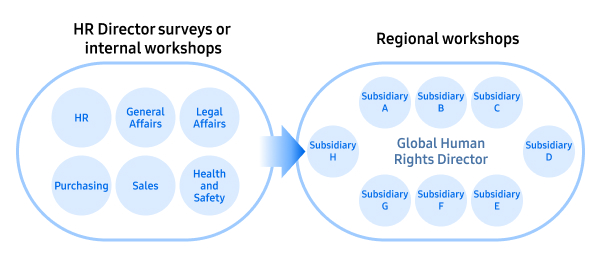
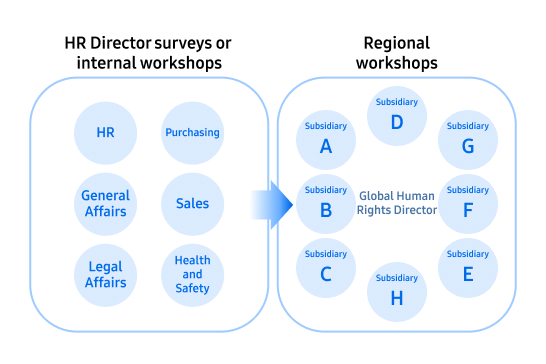 Stage 1 — HR Director surveys or internal workshops: Six departments participate: HR, General Affairs, Legal Affairs, Purchasing, Sales, and Health and Safety. Stage 2 — Regional workshops: The Global Human Rights Director coordinates with eight subsidiaries: Subsidiary A, B, C, D, E, F, G, and H. An arrow connects Stage 1 to Stage 2, indicating a sequential flow.
-
- Engaging with external stakeholders
-
Feedback on the heat maps and management plans is gathered
prior to finalizing the assessments.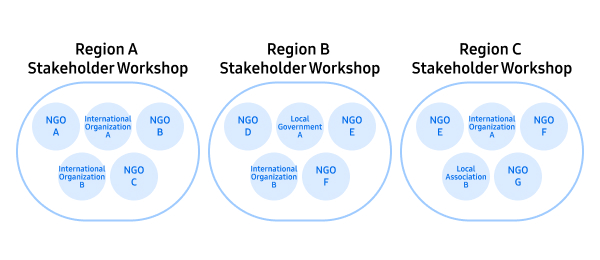
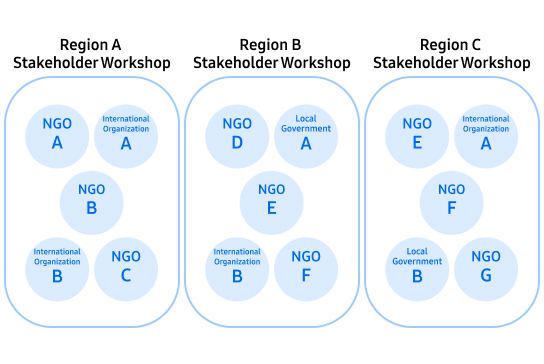 Region A Stakeholder Workshop: NGO A, International Organization A, NGO B, International Organization B, and NGO C participate. Region B Stakeholder Workshop: NGO D, Local Government A, NGO E, International Organization B, and NGO F participate. Region C Stakeholder Workshop: NGO E, International Organization A, NGO F, Local Association B, and NGO G participate.
Development of Solutions and Mitigation Plans for Negative Impacts
Alongside the heat maps, Samsung Electronics developed action plans to prevent, mitigate, and address our 11 salient human rights risks. As the final step of the HRRA, we engaged with external stakeholders, including international organizations, NGOs, and academic experts, to gather feedback on our regional action plans. This input was incorporated into our updated version of action plans, which was distributed to all subsidiaries across our five regions in December 2024. To support subsidiaries in effectively implementing these plans, additional regional workshops were held in March 2025. During these sessions, we shared best practices from subsidiaries with successfully delivered action plans and discussed challenges encountered during execution to ensure rigorous implementation of each subsidiary’s human rights risk management plan. Furthermore, to drive the effective implementation of our regional risk management plans and help each subsidiary systematically prepare its due diligence framework, we developed and distributed a standardized checklist in the third quarter of 2025, enabling all sites to conduct self-assessments.
Implementation of Plans and Effectiveness Tracking
In 2013, Samsung Electronics introduced a monitoring system to uphold labor and human rights and support compliance management at our business sites. In 2023, we upgraded this system to the Business & Human Rights Benchmark (BHRB), which evaluates DX Division manufacturing sites’ compliance with international human rights standards, such as the International Labour Organization (ILO) Declaration on Fundamental Principles and Rights at Work and the UN Guiding Principles on Business and Human Rights (UNGPs).
The assessment system has 132 indicators under 33 fields across four key categories: labor and human rights, organizational culture, working environment, and diversity, equity, and inclusion (DEI). We annually evaluate the self-assessment results from each site. When a location demonstrates a need for enhancement, we offer consulting and execute a Simplified Human Rights Impact Assessment.
Since 2023, we have conducted BHRB evaluations of the labor and human rights practices at our manufacturing sites, issued consulting reports for each, and offered guidance on areas requiring improvement. In 2025, we implemented a pilot audit using BHRB metrics at 47 global sales sites and research centers. Guided by these findings, we will pinpoint site-specific vulnerabilities and drive targeted improvements to elevate our human rights management capabilities.
Our internal labor and human rights experts select business sites in need of improving the aforementioned indicators. They review various factors such as the level of respect for labor rights in the country where our business sites are in operation, organizational culture, grievances, workforce changes, potential company policy violations, and human rights risks identified in the past. This process is known as the Samsung Electronics Simplified Human Rights Impact Assessment (sHRIA), which is a streamlined version of the full Human Rights Impact Assessment conducted by external experts.
Our sHRIA involves interviewing vulnerable groups within our sites, such as pregnant and nursing workers, migrant workers, and young workers, as well as external stakeholders within the relevant country. Through this process, we evaluate the potential and actual human rights impacts of our business operations, devise measures to prevent, mitigate, and address identified impacts, and monitor their implementation. In 2025, we conducted sHRIAs at the six sites selected through a comprehensive analysis of BHRB evaluation results and overall labor and human rights risks. Following approximately three months of preliminary and on-site assessments, we took immediate corrective actions for identified issues while introducing effective processes and systems to prevent recurrence.
In accordance with international human rights standards, Samsung Electronics created assessment tools and conducted on-site audits to respect the rights of vulnerable groups within the company, including migrant workers and women employees. We have audited four business sites employing migrant workers to ensure compliance with our Migrant Worker Policy and Policy Implementation Guide, leveraging the Responsible Business Alliance (RBA) audit methodology and key industry references.
For migrant workers in their first year of employment, we conduct surveys to verify whether they were charged any recruitment fees. In 2025, one of our subsidiaries traveled to the sending country to visit a newly partnered local recruitment agency. During this visit, it conducted on-site audits, provided training to the recruitment agency’s staff, and directly interviewed candidates applying to work at our sites.
As a member of the Responsible Business Alliance (RBA), Samsung Electronics is committed to upholding the RBA vision and goals, while implementing the RBA Code of Conduct. The Code is founded upon key international standards and benchmarks, including the Universal Declaration of Human Rights and the ILO International Labour Standards, and is regularly updated to integrate evolving global norms. Our manufacturing sites conduct annual RBA Self-Assessment Questionnaires and undergo on-site audits every two years in accordance with the RBA Validated Assessment Program (VAP) standards*.
These on-site audits are conducted by RBA-certified third-party auditors and strictly mandate worker interviews. If any non-conformance is found, the respective manufacturing site must implement remedial measures and develop a corrective action plan to prevent recurrence. The plan must be reviewed and approved by RBA-certified auditors and consequently implemented within the timeframe set by the RBA VAP standards. In 2025, a total of 15 manufacturing sites (12 in DX Division and 3 in DS Division) underwent RBA audits. Specifically, 11 of these sites achieved a perfect score of 200, earning the highest Platinum rating under the RBA VAP. While some sites had non-conformances identified in the areas of working environments, health and safety, and supply chain management, all corrective actions have been successfully completed.
We monitor the effectiveness of our human rights initiatives through various methods. To assess our efforts regarding Non-Discrimination & Diversity and Inclusion, one of our 11 salient human rights risks, we review employee responses to specific questions in our annual company-wide organizational culture survey for relevant indicators.
For initiatives related to Working Hours and Working Conditions, we measure effectiveness by conducting monthly analyses of working hours at each site, alongside an annual living wage analysis for the regions where our sites are located. Furthermore, the effectiveness of our grievance resolution mechanisms is measured through an annual employee satisfaction survey on our grievance handling process.
Operating manufacturing sites across the globe, we recognize our potential influence on working hours across the entire value chain. This impact stems from the fact that electronics demand can fluctuate sharply around holiday seasons or new product launches. The ILO notes that such volatility occurs more frequently in the upstream segments of the supply chain. Our human rights due diligence also identified excessive working hours as a potential risk at our manufacturing sites.
To address this, we monitor working hours on a monthly basis. We proactively mitigate excessive overtime risks by implementing processes such as pre-production ahead of official launches and securing overtime consent from production line employees. When a manufacturing site exhibits elevated risk, we require the submission of risk mitigation plans and track their progress.
Our continuous monthly monitoring found that sites utilizing an early warning system, which alerts managers when employees approach maximum working hour thresholds, demonstrated better risk management capabilities than other sites. Based on the findings, we have recommended the implementation of these early warning systems across other manufacturing sites that do not yet operate them.
Medium to Long-term Goals for Human Rights
Management
| Category | 2025 | 2027 | 2030 |
|---|---|---|---|
| Human Rights Due Diligence on Business Sites |
90% | 92% | 95% |
| Third-Party Audits on Suppliers |
100% | 100% | 100% |
- Samsung Electronics has set a medium to long-term goal of improving its due diligence compliance rate1) at its business sites with regard to business and human rights. To this end, the company will conduct various self-assessments, including simplified human rights impact assessments, in which vulnerable stakeholders will be engaged.
- 2025: Achieving a 90% compliance rate in its human rights due diligence;
· Simplified human rights impact assessment - six times - 2027: Achieving a 92% compliance rate in its human rights due diligence;
· Simplified human rights impact assessment - 10 times cumulative - 2030: Achieving a 95% compliance rate in its human rights due diligence;
· Simplified human rights impact assessment - 15 times cumulative
- 2025: Achieving a 90% compliance rate in its human rights due diligence;
- It is calculated as the average of VAP* compliance rate across all production sites that were subject to due diligence in the baseline and previous year, taking the due diligence cycle into account
Validated Assessment Program: a standard for social and environmental assessments of the factory introduced by Responsible Business Alliance
- At Samsung Electronics, we conduct third-party audits on suppliers with high transaction volumes and those identified as high-risk1) through due diligence following a risk-based approach. These audits align with the Responsible Business Alliance (RBA) standards and processes2). The specific number of audited suppliers varies annually.
- Insufficient self-assessment performance, failure to remediate critical violations from prior on-site or third-party audits, and the presence of potential or actual geopolitical risks such as forced labor
- Document review (employee salary information, contracts, policies, etc.), worker and manager interview (sampling a minimum of the square root of the total headcount), on-site audit (initial audit, closure audit), and subsequent remediation