SAMSUNG

SAMSUNG

  • search
  • menu

RENEWABLE ENERGY VIETNAM

Building a Renewable Energy Ecosystem in Vietnam:
Across Our Operations and Beyond

Samsung Electronics’ renewable energy* journey in Vietnam

Renewable energy refers to energy harnessed from natural sources, such as solar and wind power.

Scroll down

Toward a Clean
Energy Transition

As Asia's manufacturing landscape
rapidly grows, the need for power
increases alongside it.
This surge makes the shift to
clean energy more critical than ever.

In particular, renewable energy such as
solar power is a key driver
of
businesses’ transition to clean energy
and sustainable growth.

Yet, securing a consistent supply of
renewable energy presents ongoing
challenges for many companies.

Overcoming these challenges requires
cross-sector partnerships,
bringing together diverse stakeholders
to accelerate progress.

Collective Efforts to Drive Change

While the public sector builds policy
frameworks, power generators and energy
providers
supply renewable power and
expand grid connectivity.
Specialized organizations and industry
players bring the expertise and coordination
needed to put these plans into action.

It is only when these vital roles come
together that the renewable energy
transition truly gains momentum.


  • Government
    & Public Sector
    Build policy and
    market foundations
  • Power Generators
    & Energy Providers
    Supply renewable energy
    and expand grid connectivity
  • Enterprises &
    Specialized
    Organizations
    Drive implementation,
    and provide technical reviews
    and guidance
  • Supply Chain
    Partners
    Expand renewable energy
    adoption across the industry

As a founding member of the Asia Clean
Energy Coalition (ACEC),
an alliance supporting the clean energy
transition in Asia’s manufacturing hubs,
we are driving this collaborative progress
with various stakeholders.

On-Site PPA at SEHC

Harnessing Facility Rooftops
to Generate Renewable Energy

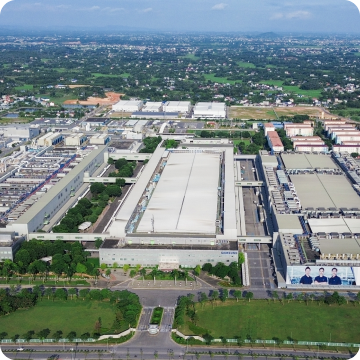
In 2026, Samsung Electronics Ho Chi Minh
City CE Complex (SEHC) launched a
large-scale on-site Power Purchase
Agreement (PPA) project by transforming
its rooftops into power generation platforms.

SEHC generates solar power directly
on previously idle roof space,
without requiring additional land.

Under this on-site PPA model,
renewable electricity is generated,
purchased, and consumed directly on-site,
enabling the complex to meet a portion of
its electricity demand with renewable power.

The SEHC rooftop installation marks
a major milestone for
large-scale
on-site PPA implementation at a single
manufacturing facility in Vietnam.
Equipped with roughly 45,000 solar panels,
the site generates over 40 GWh of
renewable electricity each year,
which is expected to reduce CO₂ emissions
by more than 26,000 tonnes annually.

This initiative signals a strategic
leap forward.
By establishing on-site
generation infrastructure,
the project lays the groundwork
to scale into off-site PPAs,
securing
large volumes of renewable electricity
through external transmission grids.

  • approx. 28 MWp Installed capacity across
    roughly 45,000 panels
  • 40 GWh+ Estimated annual renewable
    electricity generation
  • 26,000 t+ Estimated annual CO₂
    emissions reduction*

Data sourced from Vietnam Electricity (EVN) and the General Statistics Office (GSO)

Expanding
Renewable Energy
Horizons

A Direct Power Purchase Agreement
(DPPA)
is a policy mechanism
that allows corporate
buyers
to directly procure renewable energy
through agreements with private power
generators, in addition to purchasing from
state-owned utilities.

  • DPPA

    Delivering Renewable Energy
    Through the National Grid

    While an on-site PPA enables facilities
    to consume
    electricity generated
    directly within their premises,
    a DPPA sources renewable electricity produced
    off-site and delivers it
    via direct
    connections or the national grid.

    Discussions around a DPPA framework
    in Vietnam
    first began in 2019,
    culminating in July 2024
    when a government decree established
    the regulatory foundation.

DPPA at SEVT

Pioneering a
New Approach
to
Renewable Energy Procurement
Through DPPA

With the newly established regulatory
framework in place,
Samsung Electronics
Vietnam Thai Nguyen (SEVT) proactively
entered into a DPPA in 2026.
SEVT began sourcing approximately
70 GWh of solar electricity annually
through the national power grid.

The power is supplied by a renewable energy
project integrated with a Battery Energy
Storage System (BESS),
located in
southern Vietnam's Tây Ninh Province.

To ensure project viability,
Samsung Electronics consulted a global
energy firm
to design an optimal transaction
structure tailored to the business.

The 70 GWh of renewable electricity
secured annually by SEVT is
equivalent to
the power consumed by roughly
17,000 households in Vietnam each year.
Through this agreement, the site expects
to reduce annual CO₂ emissions
by approximately 46,000 tonnes.

As a pioneering transaction under
Vietnam’s DPPA framework,
it demonstrates how the regulatory
foundation
and collaboration among diverse
stakeholders can enable tangible renewable
energy procurement for businesses.

  • 70 GWh Estimated annual
    renewable
    electricity supply
  • 17,000 Equivalent number of
    households
    powered
    annually*
  • 46,000 t Estimated annual
    CO₂
    emissions
    reduction*

Data sourced from Vietnam Electricity (EVN) and the General Statistics Office (GSO)

Aggregated Demand Creates New Markets

The experience we have gained through
our own energy transition in Vietnam
now provides a practical foundation
for supporting our local suppliers.

However, for suppliers
with lower electricity demand,
executing independent renewable power
purchase agreements remains
a practical challenge.

To overcome this, aggregating individual
power demand into collective purchasing
volume
creates the scale
needed to reshape the market.
In doing so, businesses can help stimulate
the development of new renewable energy
projects
while securing more favorable
procurement conditions.

Building a Renewable Energy
Ecosystem Together

Looking ahead, Samsung Electronics will
continue to support our suppliers in Vietnam
by bringing together individual demand
to create meaningful scale and
leveraging our procurement experience
and expertise to facilitate their transition
to renewable energy.

By lowering barriers to procurement
and working closely with stakeholders
across the ecosystem,
we aim to help foster a
sustainable market environment in which
renewable energy is more accessible.

As we advance step-by-step toward
our renewable energy transition and
net-zero goals,
we will continue
to connect and collaborate with partners
across the ecosystem,
driving lasting change across the industry.

FAQ

We aim for 100% renewable energy across DX Division and our overseas sites* by 2027,
and across all Samsung Electronics operations, including DS Division (semiconductor business), by 2050.

Overseas sites include Samsung Electronics sites outside South Korea operated by both DX and DS Divisions.