We respect the freedom and fundamental rights to which all people are entitled
We ensure equal opportunities for all of our employees and applicants, and we do not tolerate discrimination of any kind. We also respect the freedom of association of all of our employees. Furthermore, we strive to embed and integrate the respect for human rights into our business in order to protect and promote the rights of our employees and people in our supply chain.
Our Framework for Labor and Human Rights
In strong support of the UN Guiding Principles on Business and Human Rights(UNGPs), we established and embedded our own framework for human rights to identify, prevent, mitigate and account for any adverse human rights impacts across our business activities.
We also endeavor to ensure that our first-tier suppliers undertake the same level of scrutiny of human rights risks as ours at their operations. Further, we oblige them to have their suppliers, or sub-suppliers to Samsung, to apply the same level of our working environment policies.
Governance
Our Global Labor Issues(GLI) Committee manages the impacts and risks on labor and human rights. The GLI Committee, which convenes bi-weekly to discuss labor and human rights issues, consists of executives and working-level employees from Six functions(Human Resources Team, Legal Office, Partner Collaboration Center, Corporate Sustainability Center, Global EHS Center, Investor Relations Team). Any important matters are escalated to the Sustainability Council, which consists of key executives, and then reported to
the top management.
Policies
We have established a robust set of labor and human rights policies based on Universal Declaration of Human Rights, the United Nations Guiding Principles on Business and Human Rights(UNGPs); Organization for Economic Co-operation and Development(OECD) Guidelines for Multinational Enterprises; UN Convention on the Rights of the Child(UNCRC); International Labor Organization(ILO) Declaration on Fundamental Principles and Rights at Work. We abide by the Code of Conduct of the Responsible Business Alliance(RBA) and comply with the laws and regulations of the countries where we conduct our business.
Global Code of Conduct and Guidelines
All employees are obliged to comply with the ‘Global Code of Conduct’ and ‘Business Conduct Guidelines’, which are part of our efforts to be more responsible in our business activities.
Labor policies
We develop and implement a set of policies dedicated to protecting vulnerable groups.
We have been providing our employees with training programs tailored to each worksite, with the aim of complying with our human rights policies and raising awareness about respecting human rights. In collaboration with UN agencies, as well as organizations specialized in business and human rights education, we strive to increase their capabilities in dealing with labor and human rights topics by offering training customized to job functions. After developing training materials tailored to job responsibilities of all employees in collaboration with BSR, we launched our comprehensive labor and human rights training program in 2020. We will continue to deliver customized training to any relevant topics.
Due diligence
We operate a system equipped with both internal and external protocols in order to identify and monitor human rights risks at our worksites and across our supply chain.
Our worksites
We evaluate the level of labor and human rights compliance and monitor activities for improvement using three different protocols; RBA on-site audit, Samsung Electronics Internal Risk Assessment, Human Rights Impact Assessment(HRIA).
Responsible Business Alliance on-site audit
As a member of the Responsible Business Alliance(RBA), we apply the RBA Code of Conduct to our worksite management. Based on the results of RBA SAQ(Self-Assessment Questionnaire) by our worksites, we select six or seven of them every year and apply the RBA on-site audit protocol to identify working environment risks at those worksites. According to the protocol, a third party audit firm approved by RBA carries out audits in terms of labor, health and safety, environment, ethics and management systems. If any finding is identified, the worksites shall submit and implement a corrective action plan.
Samsung Electronics internal
risk assessment
-
01. Select assessment targets
Select six to seven worksites every year that are required to increase capabilities and make overall improvements based
on the monitoring
system’s assessment results.Our worksite
monitoring systemIt supports the enforcement of
labor and human rights standards
and compliance management, as a
monitoring system to assess
our
working environment, workplace culture, representative bodies, and management of suppliers, etc. -
02. Audit team setup
Organize an expert group comprised of employees qualified including certified RBA auditors.
-
03. Self assessment
Self assessment of sites based on the inspection checklist
-
04. On-site audit
Conduct an on-site audit based on Samsung Electronics Standards
-
05. Follow-up management
Share inspection results with the management team of respective worksite
Establish future improvement plans and measures to prevent recurrence within one week from the completion
of inspectionImplement improvement tasks by
forming a task force consisting of
experts in human resources and environmental safetyMonitor progress of improvement tasks on a monthly basis via worksite monitoring system
Human Rights Impact Assessment (HRIA)
We conduct human rights impact assessments to identify actual and potential risks to and adverse impacts on human rights that we may have caused, are linked to, or have contributed to. Our first human rights impact assessment was carried out in Vietnam in 2018. At that time, to maintain an objective point of view in the process, we collaborated with BSR(Business for Social Responsibility), a non-profit organization specialized in business and human rights.
We strive to address the issues identified in due diligence with remediation, mitigation and prevention measures in place including developing and revising policies, providing capacity-building programs and improving work processes across our operations.
Supply chain
We align our Supplier Code of Conduct with the RBA Code of Conduct and share the updates with our suppliers. We also provide a guide to help them comply with the Code of Conduct and implement compliance management in their operation. In accordance with RBA’s verification standards, we regularly monitor all of our suppliers to make sure they identify issues and make necessary improvements. Our 1st-tier suppliers are also required to encourage their suppliers, or sub-suppliers to Samsung, to ensure safe working environment.
Access to remedy
Our grievance resolution procedure is based on the “Effectiveness criteria of non-judicial grievance mechanisms” stipulated in the 31st clause of the UN Guiding Principles on Business and Human Rights. Anyone can raise a formal complaint and must not be discriminated or face retribution for raising the complaint. We endeavor to ensure the procedure is transparent and the rights of those involved are respected at all steps of the procedure. We also guarantee anonymity of anyone who files a complaint.
Grievance reporting channels
We operate various grievance channels taking into account the characteristics of the worksite and local situations.
01. Online
Company intranet
02. Offline
Suggestion boxes placed in area with no CCTV
03. Hotline
Call or email
04. Committee
Works council, employee committee
05. Mobile
Company intranet application
06. SNS
Company communication channel
※ Channels for external stakeholders : https://sec-audit.com | civilsociety@samsung.com
※ Channels for external stakeholders :
https://sec-audit.com
civilsociety@samsung.com
Grievance resolution procedure
-
01
Grievance report
Notification of
receipt
within 24
hoursEmployees and
external
stakeholders
report all
grievances
related to the
companyA case manager is
designated -
02
Grievance confirmation
and reviewWithin 5 days of
receiptConfirm details and
facts
of reported
grievanceListen to grievant
about
desired
measuresReview remedial
measures
according to
confirmed
details -
03
Results
notificationWithin 7 days of
receiptDeliver results of
review
and gather
feedback from
grievant -
04
Grievance resolution
Varies by case
Grievance is resolved
through measures
such
as
training, disciplinary
action against the
accused, providing
useful
information or
support,
and
improving
infrastructures, related
policies and procedures
※ If each step is not processed by the time frame
due to reasonable reason, the grievant will be
notified of specific reason
Transparency & reporting
We report in detail on how we respect labor and human rights across our business activities in our Sustainability Report based on the GRI standard among others.
In addition, under the UK Modern Slavery Act, we report our annual statements to the Modern Slavery Registry.
We are one of the selected companies by two most influential industry benchmarks; the Corporate Human Rights Benchmark(CHRB) and Know the Chain(KTC). While CHRB focuses on comparing and assessing companies in terms of human and labor rights, KTC closely looks at forced labor issues.
Stakeholder engagement
We continue to engage with global stakeholders to foster the culture of respect for human rights not only in our business but also in our industry. In developing policies and training programs, we collaborate with organizations or agencies specialized in human rights and participate in various multilateral initiatives.
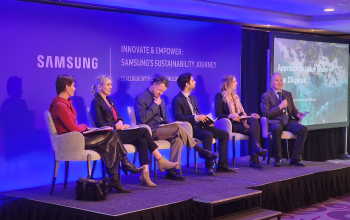
Since 2018, we have hosted multi-stakeholder forums in Vietnam every year. In 2020, we held the 3rd forum in cooperation with VCCI(Vietnam Chamber of Commerce and Industry) and VGCL(Vietnam General Federation of Labor) and had a discussion under the theme "Covid-19 Crisis Management and Countermeasures, Human Resources Management and Technology Change after Covid-19 Pandemic". The forum welcomed more than 200 stakeholders, including experts and guests from NGOs, media, and academia.
In collaboration with the International Organization of Migration(IOM), we have hosted several workshops on Modern Slavery and Ethical Recruitment, which are participated by our employees, suppliers, and business partners at worksites in Hungary, Slovakia, and Malaysia. The workshops have served as a great opportunity to raise awareness about the protection of migrant workers’ human rights and to share the importance of eradicating forced labor.
Working with the German development agency(GIZ), and partners like BMW Group and BASF, we have launched “Cobalt for Development(C4D)”, a pilot project at an artisanal cobalt mine in the Democratic Republic of Congo. As part of the project, we are carrying out various activities to help bring about real progress to the local community, such as providing occupational safety training for local miners and building new elementary and secondary schools for local children.