Troubleshoot display issues on your Samsung Galaxy device

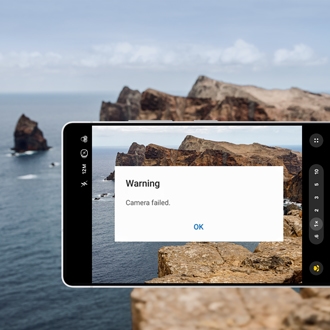
If your Galaxy device display is not working properly, the issue may be caused by temporary system errors, outdated software, display settings, or physical damage from external impact. Problems such as an unresponsive touchscreen, unusual screen colors, or abnormal display behavior may also occur depending on your settings or software version.
A woman tapping on the screen of a Galaxy phone.

Troubleshoot display issues on your Samsung Galaxy device

Note
  • If the display is physically damaged from external impact, the device may not function normally.
  • Menu names, settings, and screen layouts may vary depending on the model and software version.

When the display is not working properly

If the display is not responding normally, the issue may be caused by temporary system errors, outdated software, app compatibility issues, or physical damage. Follow the guidance below to improve display performance.

Restart your device

A temporary system error may cause the display to stop responding normally. Restart your device and check again.

  1. Press and hold the side key and volume down key at the same time for more than 2 seconds.
    Side key highlighted on a Galaxy device.
  2. Tap Restart.
    A screen showing the Power menu options, with the Restart button highlighted.
  3. If the Restart menu does not appear, press and hold the side key and volume down key at the same time for more than 7 seconds until the device restarts automatically.

Update your device software

Outdated software or apps may cause compatibility issues or abnormal display behavior. Make sure your device software and apps are updated to the latest version.

  1. Open Settings, then tap Software Update.
  2. Tap Check for updates.
     Software update screen with the Check for updates option highlighted.
  3. Follow the on-screen instructions. A confirmation will appear once the software is up to date.

Update apps from the Google Play Store

Outdated apps may cause screen display issues or abnormal behavior due to compatibility problems. Check for app updates to help keep your device working properly.

  1. Open the Google Play Store app, then select your Google account.
    Google Play Store app screen with the profile icon highlighted.
  2. Tap Manage apps & device to check for available updates.
  3. Tap Update all.

Check for physical damage

If the display was damaged by strong external impact, it may not function properly.

Stop using the device immediately and visit a nearby Samsung service center to have the device inspected.

Read less

When the screen looks different than expected

You can adjust display settings such as text size, screen zoom, screen color, dark mode, motion smoothness, screen resolution, and adaptive brightness for better visibility and comfort.

Adjust text size and style

If you find the text on your screen too small or want to change the font style, you can easily adjust both the text size and style on your device.
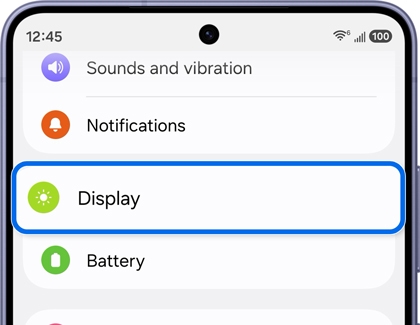
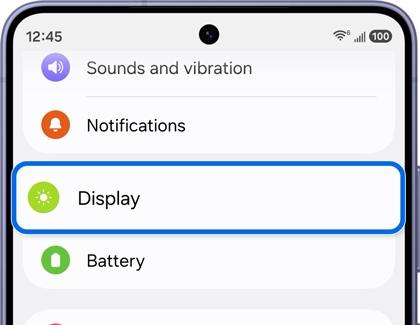
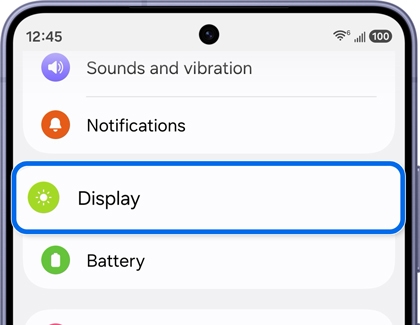
  1. Open Settings, then tap Display.
    Samsung Galaxy settings menu with the Display option outlined in blue.
  2. Tap Font size and style. 
    Display menu with the Font size and style option highlighted.
  3. Select the desired Font style and Font size.
    Font size and style screen with options to adjust the font size slider and style.

Adjust screen zoom

To make text and images bigger or smaller, you can adjust the screen zoom on your device. 
  1. Open Settings, then tap Display.
    Samsung Galaxy settings menu with the Display option outlined in blue.
  2. Tap Screen zoom.
  3. Use the minus (-) or plus (+) slider to adjust the screen size.
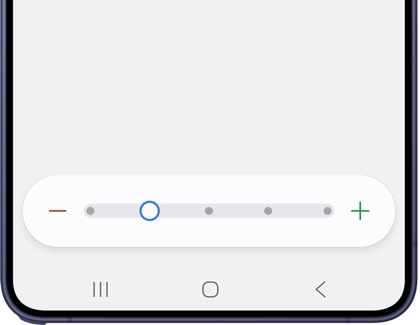
    A screen with a slider to increase or decrease zoom.

Turn off Eye comfort shield

If the screen appears yellow or warmer than expected, the Eye comfort shield feature may be enabled.

  1. Open Settings, then tap Display.
    Samsung Galaxy settings menu with the Display option outlined in blue.
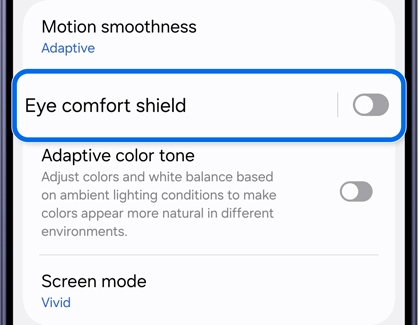
  2. Turn off Eye comfort shield. 
    Display menu with the Eye comfort shield toggle turned off.

Adjust Dark mode

Dark mode can help reduce eye strain in low-light conditions and provide a more comfortable viewing experience.
  1. Open Settings, then tap Display.
    Samsung Galaxy settings menu with the Display option outlined in blue.
  2. Tap Dark to activate it or Light to disable it.
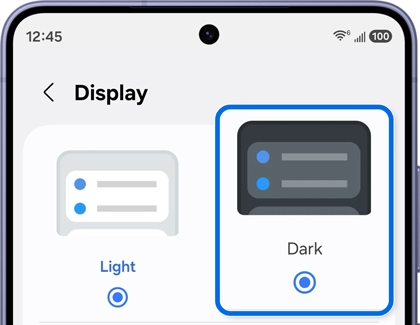
    Samsung Galaxy Display settings screen with Dark mode outlined in blue.


Turn on Adaptive Brightness

Adaptive brightness automatically adjusts the screen's brightness based on the surrounding lighting conditions.

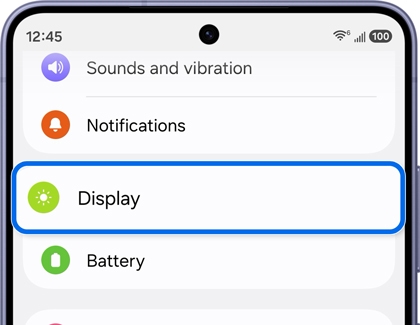
  1. Open Settings, then tap Display.
    Samsung Galaxy settings menu with the Display option outlined in blue.
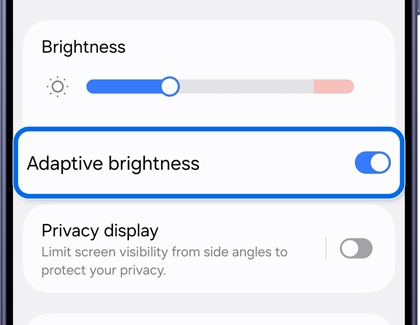
  2. Turn on Adaptive brightness.
    Samsung Galaxy Display settings screen with the Adaptive brightness toggle outlined in blue.
  3. You can also manually adjust the brightness level by swiping down from the top of the screen to open the Quick panel settings and using the Brightness slider.

Change the Motion smoothness

Motion smoothness optimizes the screen's refresh rate for smoother visual experiences.

  1. Open Settings, then tap Display.
    Samsung Galaxy settings menu with the Display option outlined in blue.
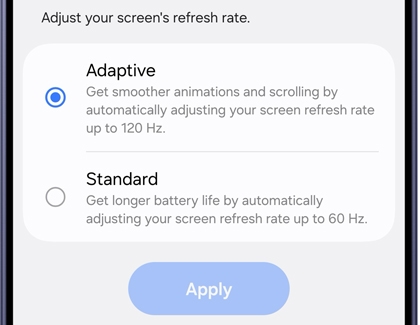
  2. Tap Motion smoothness, then select a different option:
    • Adaptive for dynamic refresh rate adjustments.
    • Standard for optimal battery life.
      Samsung Galaxy motion smoothness settings screen showing Adaptive and Standard refresh rate options.
Note
Some devices may not have this option available, depending on the model.

Adjust the Screen resolution

Changing the Screen resolution can make things look sharper, help your battery last longer, and improve how photos and videos appear.

  1. Open Settings, then tap Display.
    Samsung Galaxy settings menu with the Display option outlined in blue.
  2. Tap Screen resolution, and then select a different option.
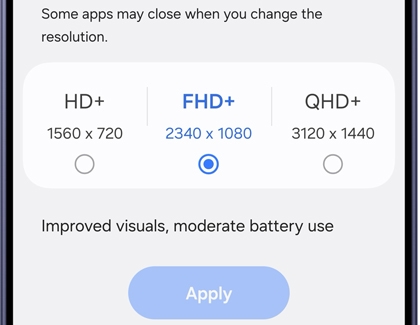
    Samsung Galaxy screen resolution settings showing HD plus, FHD plus, and QHD plus options.
Read less

When dark lines, streaks, or glare appear in photos or videos

Note
Flicker may occur due to lighting frequency and is a normal camera behavior.

Dark lines appear while taking photos or videos

If the screen flickers or black lines appear when taking photos or videos, this may be caused by indoor lighting. Try the steps below to resolve the issue.

  1. Open the Camera app, then tap MORE and select the PRO mode.
    Camera screen with MORE and PRO highlighted.
  2. Select the shutter speed.
    PRO mode screen with the settings panel at the top highlighted.
  3. Adjust the shutter speed to 1/120s or lower.
    Comparison of a photo showing horizontal dark lines vs. without dark lines.

Photos show light streaks or glare

Light streaks or glare (lens flare) can occur during photography, especially in bright lighting conditions or at night when there are many light sources. This effect may be more noticeable if the lens is dirty or when using high zoom.

  • Clean the camera lens to remove fingerprints, dust, or smudges.
  • Adjust your shooting conditions, such as changing the angle or avoiding strong light sources when possible.
  • Use AI editing features to reduce light effects.


How to use AI editing features

  1. Open the Gallery app and select your desired photo, then tap the Photo assist icon (the cluster of stars).
  2. Tap or draw around anything you want to move or delete.
    A circular area drawn around a light streak in a photo.
  3. Tap Erase.

    Erase button highlighted below an image.

    Comparison of a photo with an unwanted light streak vs. cleaner image.
If you're experiencing issues with blurry or poor photo and video quality, click here to refer to our detailed troubleshooting guide for step-by-step solutions.
Read less

When the touchscreen is not working properly

You can use the Samsung Members app to check the touchscreen status.

  1. Open the Samsung Members app.
  2. Tap Diagnostics.
    Samsung Members app home screen with the Support option highlighted.
  3. Tap Phone diagnostics.
    The Diagnostics screen, highlighting Phone diagnostics.
  4. Select Touch screen.
    The list of Phone diagnostics tests, highlighting Touch screen.

    Note:
    Start the full diagnostics first, stop the test, and then select the item you want to test.
  5. Touch all empty areas on the screen with your finger.
    The Touch screen diagnostics test, showing a grid on the screen.
  6. Once all areas are filled, check the touchscreen test results.
    The final result screen of the Touch screen diagnostics test.
Read less

When the screen is cracked or damaged


If your Samsung Galaxy device screen is cracked or damaged, click here for detailed support options.
Read less
Was this content helpful?
We're here for you

Contact Samsung Support

Contact us online through chat and get support from an expert on your computer, mobile device, or tablet. Support is also available on your mobile device through the Samsung Members App.